
 All
All AI & ML
 Healthcare
 Education
 Games
Games Fitness
 Business
 Webapps
 Websites
 More
More Case Studies
 Startup
 Web3 Development
 Capabilities
 Game Development
 Website Development
 Prototyping Services
 Mobile App Development
 Government Contracts
 Client Dashboard
 Design Process
 IP Protection
 Project Management
 Working with Finally Free
 FAQ
FAQ How to Videos
 About FFP
 Meet The Team
 Press
Press- Our Work
-
-
PORTFOLIO
OTHERS
-
-
- Services
-
- How We Work
-
- Resources
-
- About Us
-
- Contact Us
- Let’s Talk
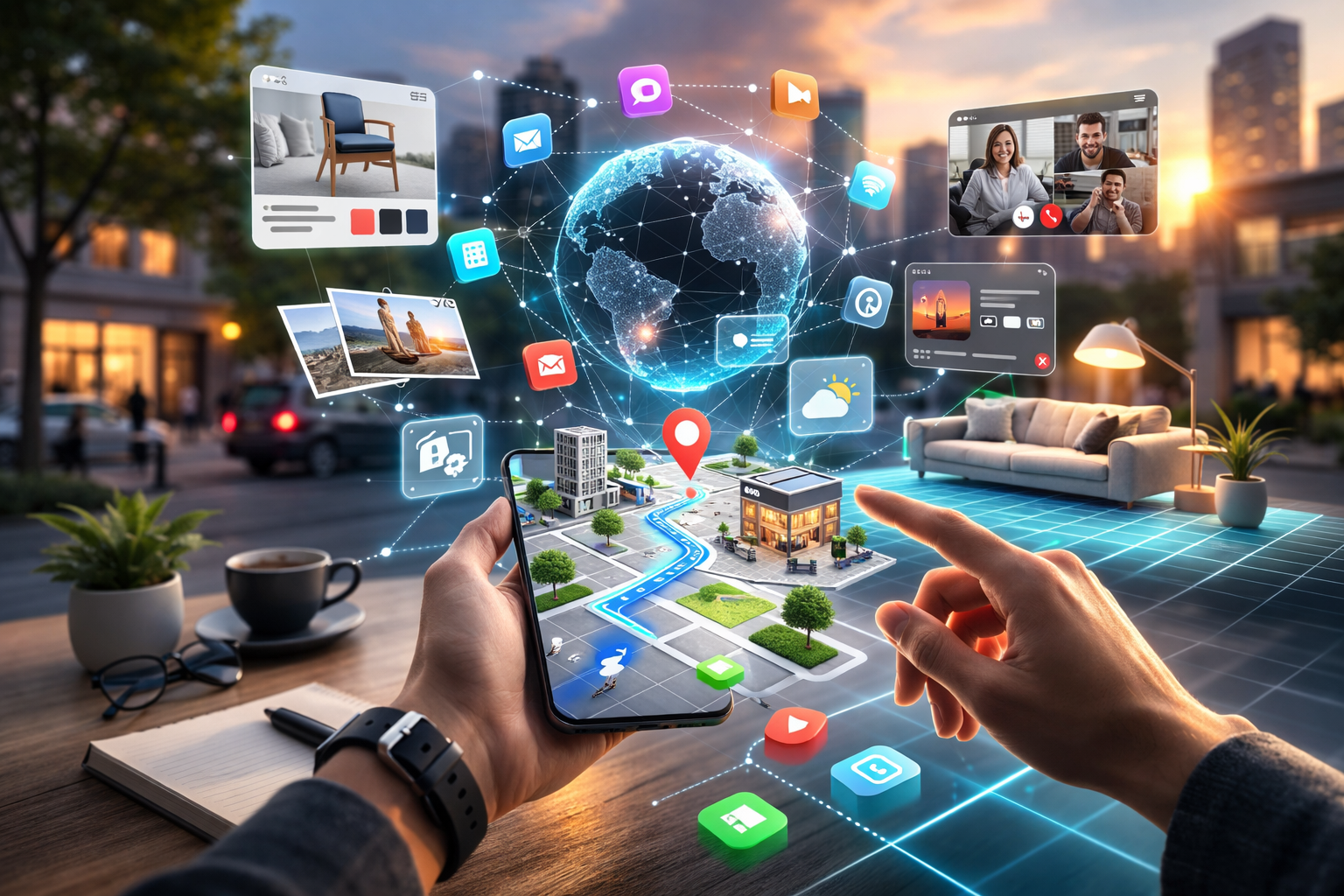
The way we interact with digital technology is changing—and it’s happening faster than most people realize. Spatial computing and augmented reality (AR) are no longer experimental technologies reserved for gaming or high-end enterprise tools. They are actively reshaping how everyday apps function, how users interact with information, and how businesses deliver digital experiences.
At Finally Free Productions, we closely track these shifts because immersive technologies are redefining user engagement, product design, and digital strategy across industries.
Let’s explore what spatial computing and AR really mean for everyday applications—and why businesses must prepare now.
What Is Spatial Computing?
Spatial computing refers to technology that enables digital systems to understand and interact with physical space in real time. Unlike traditional computing—which operates within flat screens—spatial computing allows digital content to exist and respond within three-dimensional environments.
It combines:
Augmented Reality (AR)
Virtual Reality (VR)
Mixed Reality (MR)
Computer vision
AI-powered spatial awareness
Real-time environmental mapping
Devices such as AR-enabled smartphones, LiDAR-equipped tablets, and spatial headsets (like Apple Vision Pro or Meta Quest) are accelerating adoption.
The result? Apps that understand space, depth, movement, and context.
How AR Is Transforming Everyday Apps
1. Productivity and Collaboration
Traditional productivity apps live inside screens. Spatial computing extends them into your environment.
Examples:
Virtual multi-screen workspaces projected into physical space
3D data visualization tools
Immersive remote collaboration rooms
Real-time AR annotation on physical objects
Instead of toggling between tabs, users can organize information spatially—making workflows more intuitive and immersive.
For businesses, this means:
Higher engagement
Faster comprehension of complex data
Improved remote collaboration
2. Retail and E-Commerce
AR is already transforming online shopping.
Consumers can:
Virtually place furniture in their homes
Try on clothing or accessories digitally
Visualize products at real-world scale
This reduces returns, increases buyer confidence, and improves conversion rates.
Spatial computing adds deeper context:
AI-powered environment matching
Lighting adaptation for realism
Interactive 3D product storytelling
For brands, this means experiential commerce—not just online transactions.
3. Education and Training
Spatial computing turns passive learning into interactive experience.
Instead of reading about anatomy, students can explore 3D models. Instead of watching a tutorial, workers can receive real-time AR guidance overlaid onto equipment.
Industries seeing rapid adoption:
Healthcare
Engineering
Manufacturing
Government training programs
The key shift: learning becomes immersive and situational.
4. Navigation and Smart Cities
AR-powered navigation overlays digital directions onto real-world streets and environments.
Future-ready apps will:
Highlight walkable paths in real time
Display contextual data about buildings
Provide accessibility-optimized routes
As cities become smarter, spatial computing will act as the interface between digital infrastructure and human interaction.
5. Social and Communication Platforms
Social apps are evolving from text and 2D video into shared spatial experiences.
Expect:
Persistent AR environments
Digital objects anchored in real-world locations
Collaborative immersive spaces
Communication becomes experiential rather than screen-based.
Why This Matters for Businesses and Developers
Spatial computing represents a fundamental shift in user expectations.
Users will increasingly expect:
Context-aware interfaces
Interactive 3D content
Seamless blending of digital and physical environments
Businesses that fail to adapt may appear outdated within just a few years.
For development teams, this means:
Designing for 3D environments, not just flat UI
Integrating computer vision and AI
Prioritizing spatial UX strategy
The transition is similar to the move from desktop to mobile—but potentially even more transformative.
The Strategic Advantage of Early Adoption
Early adopters of spatial computing gain:
Stronger brand differentiation
Higher engagement rates
Competitive positioning as innovators
Deeper data insights through immersive interaction
At Finally Free Productions, we see spatial computing not as a trend—but as the next computing platform.
The Technical Foundation Behind the Shift
Spatial computing relies on:
Real-time environmental mapping
Depth sensors and LiDAR
AI-powered object recognition
Edge computing
3D engines like Unity and Unreal
Advanced UX design frameworks
Businesses entering this space need both technical capability and strategic vision.
Preparing for the Spatial Future
If your organization is evaluating how spatial computing fits into your roadmap, consider:
What user interactions could benefit from 3D context?
Where could AR reduce friction or increase clarity?
How can immersive experiences differentiate your brand?
What internal workflows could improve through spatial visualization?
The goal is not to adopt AR for novelty—but to solve real user problems in more intuitive ways.
Final Thoughts
Spatial computing and AR are not distant concepts—they are rapidly becoming foundational layers of digital interaction.
Everyday apps will soon:
Understand physical space
Respond to user context
Merge digital content seamlessly with reality
The companies that invest now will define how users experience technology over the next decade.
At Finally Free Productions, we continue researching, building, and implementing immersive solutions that bridge innovation and practical deployment. The future of everyday apps isn’t flat—it’s spatial.
