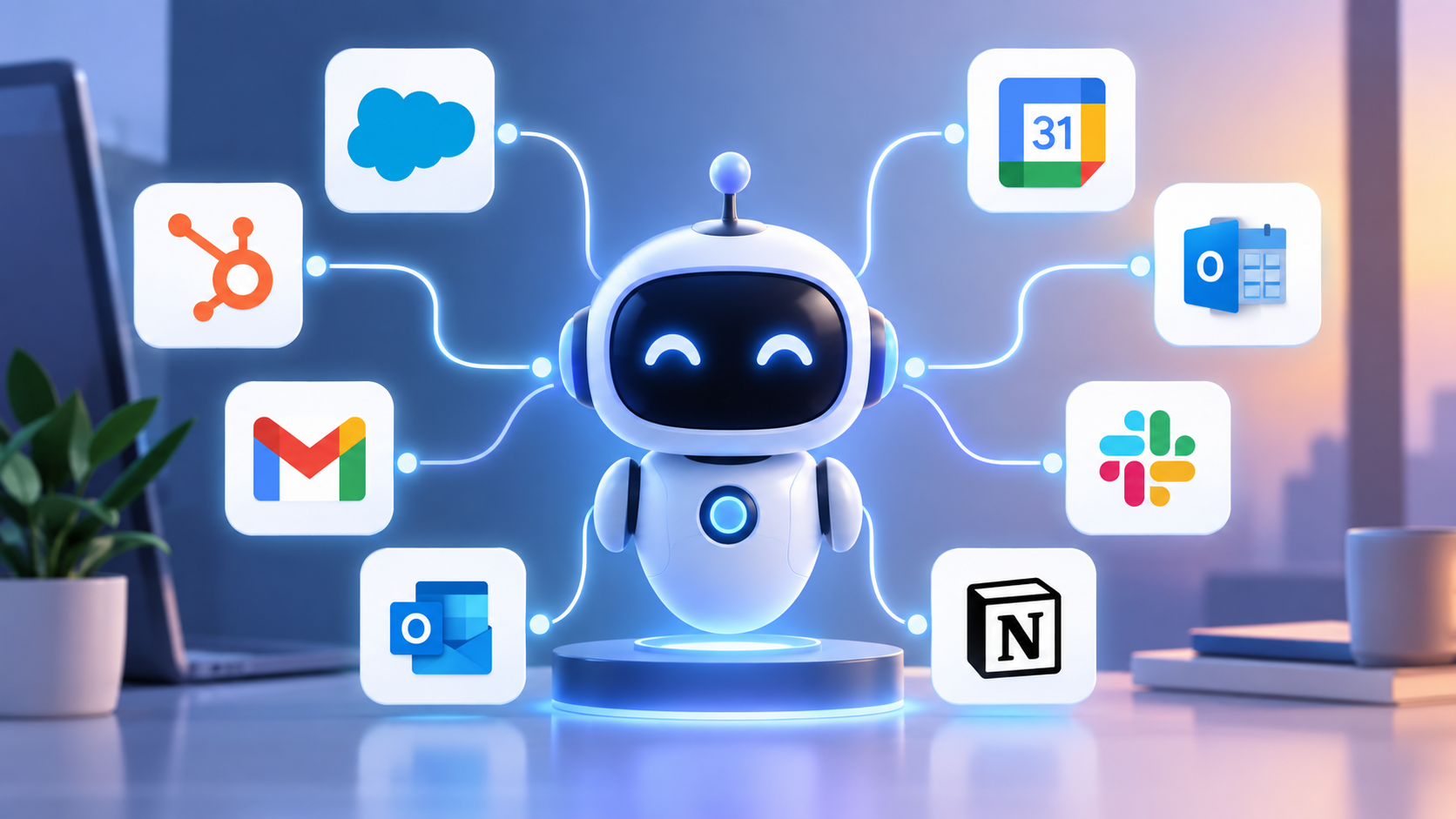
How AI Agents Connect to CRMs, Email, Calendars, and Internal Tools
AI agents are moving beyond standalone chatbots. Today, businesses can connect AI agents to the systems their teams already use—including CRMs, email platforms, calendars, databases, project management systems, and custom internal tools.
These AI agent integrations allow an agent to do more than generate an answer. With the right permissions and infrastructure, an AI agent can retrieve information, trigger workflows, update records, coordinate tasks, and take approved actions across multiple business systems.
How AI Agent Integrations Work
At a high level, AI agents connect to business applications through technologies such as APIs, webhooks, plugins, connectors, databases, and custom integrations.
The AI agent acts as an intelligent layer between the user and connected systems. Instead of requiring an employee to manually move between several applications, an agent can interpret a request, determine what information or action is needed, interact with authorized systems, and return the result.
For example, a sales representative could ask an AI agent to review a customer’s account, summarize recent communications, identify outstanding opportunities, and schedule a follow-up meeting. The agent could potentially complete that workflow by securely interacting with the organization’s CRM, email, and calendar systems.
Connecting AI Agents to CRMs
CRM integration can give AI agents controlled access to customer and sales information.
Depending on permissions, an AI agent could:
Retrieve customer or prospect information
Summarize account activity
Create or update CRM records
Identify leads requiring follow-up
Draft personalized sales communications
Log interactions and meeting notes
Trigger predefined sales workflows
This can reduce repetitive data entry while helping sales and customer service teams access relevant information faster.
An authorized AI agent can potentially monitor designated inboxes, categorize messages, extract important information, draft responses, create follow-up tasks, or route requests to the appropriate person.
For example, an incoming customer inquiry could be analyzed automatically. The agent might identify the customer, retrieve relevant account information, prepare a response, and flag the message for employee approval.
The exact level of autonomy should depend on the organization’s security requirements and the sensitivity of the workflow.
Connecting AI Agents to Calendars
Calendar integrations allow AI agents to help coordinate schedules and meetings.
Agents can be configured to check availability, identify appropriate meeting times, create calendar events, send invitations, and incorporate scheduling into larger automated workflows.
A request such as “Schedule a follow-up with this prospect next week” could involve checking CRM information, finding available calendar slots, preparing the meeting invitation, and updating the associated sales record.
Connecting AI Agents to Internal Tools
Some of the most valuable AI agent applications involve proprietary business systems.
Through secure APIs and custom integrations, organizations can connect AI agents to internal databases, knowledge bases, dashboards, inventory systems, project management applications, ticketing platforms, and other operational software.
This makes it possible to build agents around workflows unique to the organization rather than limiting automation to commercially available applications.
Security and Permissions Matter
Connecting AI to business systems also introduces important security considerations.
Organizations should establish clear authentication, authorization, data-access, logging, and approval policies. An AI agent should generally receive only the permissions required to perform its intended responsibilities.
For higher-risk actions—such as financial transactions, deleting records, sending sensitive communications, or modifying critical systems—human approval and additional safeguards may be appropriate.
The Bigger Opportunity: Connected AI Workflows
The real value of AI agents emerges when multiple systems work together.
Rather than automating a single task, businesses can create connected workflows spanning sales, customer service, operations, marketing, administration, and other departments.
An AI agent might retrieve information from one system, analyze it, update another platform, notify the appropriate employee, and schedule the next action—all within a governed workflow.
For organizations exploring AI adoption, the question is increasingly shifting from “What can AI generate?” to “What business processes can AI securely help execute?”
At Finally Free Productions (FFP), we help organizations explore practical AI, automation, integration, and digital transformation opportunities that connect technology to real operational needs.
The next generation of business AI isn’t just about smarter conversations. It’s about connecting intelligence to the systems where work actually happens.

 All
All AI & ML
 Healthcare
 Education
 Games
Games Fitness
 Business
 Webapps
 Websites
 More
More Case Studies
 Startup
 Web3 Development
 Capabilities
 Game Development
 Website Development
 Prototyping Services
 Mobile App Development
 Government Contracts
 Client Dashboard
 Design Process
 IP Protection
 Project Management
 Working with Finally Free
 FAQ
FAQ How to Videos
 About FFP
 Meet The Team
 Press
Press