
 All
All AI & ML
 Healthcare
 Education
 Games
Games Fitness
 Business
 Webapps
 Websites
 More
More Case Studies
 Startup
 Web3 Development
 Capabilities
 Game Development
 Website Development
 Prototyping Services
 Mobile App Development
 Government Contracts
 Client Dashboard
 Design Process
 IP Protection
 Project Management
 Working with Finally Free
 FAQ
FAQ How to Videos
 About FFP
 Meet The Team
 Press
Press- Our Work
-
-
PORTFOLIO
OTHERS
-
-
- Services
-
- How We Work
-
- Resources
-
- About Us
-
- Contact Us
- Let’s Talk
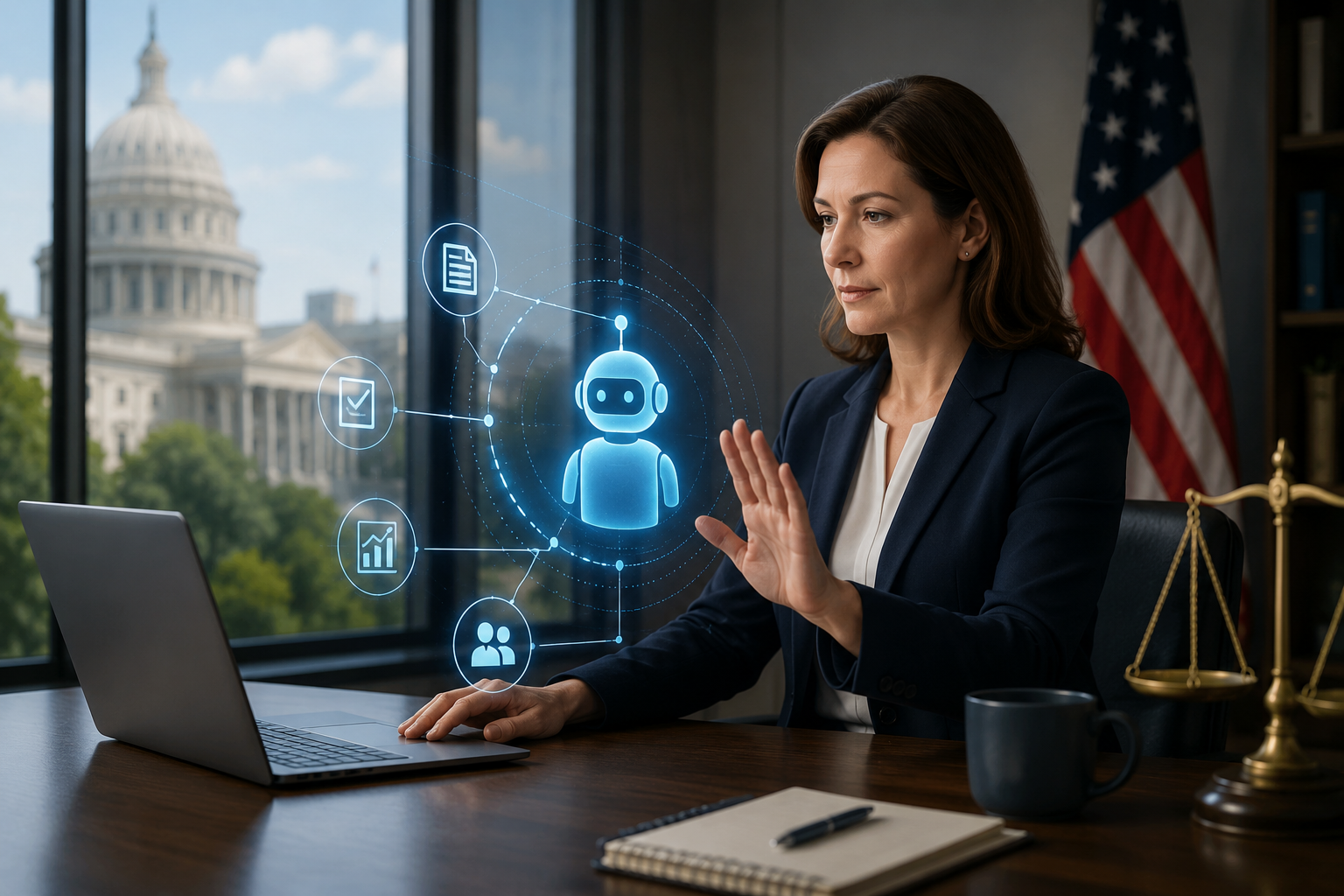
Artificial intelligence is rapidly changing how organizations automate work, analyze information, and support decision-making. For government agencies, AI agents present an especially promising opportunity.
Unlike traditional automation, AI agents can perform multi-step tasks, interact with systems, process information, and take actions based on predefined goals and rules. This can help agencies reduce repetitive work, improve response times, and allow employees to focus on higher-value responsibilities.
But greater autonomy creates an important question: How can government agencies use AI agents without giving up human oversight?
The answer is not to remove people from the process. It is to design AI-enabled workflows where automation and human judgment work together.
What Are AI Agents?
AI agents are software systems designed to pursue objectives and perform tasks with varying levels of autonomy. Depending on how they are configured, an agent might retrieve information, analyze documents, generate reports, monitor systems, route requests, communicate with other applications, or recommend a next action.
Within government operations, potential applications include:
- Processing and classifying routine documents
- Supporting internal knowledge searches
- Routing citizen or employee requests
- Monitoring operational data
- Assisting with research and reporting
- Preparing preliminary summaries and recommendations
- Automating repetitive administrative workflows
The goal should not necessarily be to automate every decision. Instead, agencies can identify where AI creates efficiency while preserving human authority where judgment, accountability, or risk demands it.
Build Human Oversight Into the Workflow
One of the strongest approaches is human-in-the-loop AI.
Rather than allowing an AI agent to independently complete every action, agencies can establish checkpoints where designated personnel review, approve, reject, or modify an AI-generated recommendation.
For example, an AI agent could analyze incoming information and prepare a recommended action. A government employee could then review the supporting information before authorizing the next step.
This model allows agencies to benefit from automation while keeping decision-making authority in human hands.
Define What AI Can—and Cannot—Do
Effective AI governance begins with clear boundaries.
Before deploying an AI agent, agencies should establish its authorized functions, the systems and information it can access, the actions it can perform independently, and the circumstances that require human approval.
Higher-impact activities should generally receive stronger controls.
An agent that organizes internal documents, for instance, presents a different level of risk than a system whose output could affect benefits, enforcement, procurement, personnel, security, or other consequential government activities.
The level of human oversight should reflect the potential impact of the AI system.
Maintain Auditability and Accountability
Government AI systems should also be designed with accountability in mind.
Agencies should be able to determine what an AI agent did, what information it used, what actions were taken, and when human intervention occurred.
Depending on the application and applicable requirements, this may involve activity logs, access controls, approval histories, version tracking, monitoring, and documented escalation procedures.
These controls do more than support compliance. They help agencies investigate problems, evaluate performance, and continuously improve AI-enabled workflows.
Keep Security and Data Governance at the Center
Government agencies often operate with sensitive information and complex security requirements. AI adoption therefore needs to align with the agency’s existing cybersecurity, privacy, records management, data governance, and access-control obligations.
An AI agent should receive only the access necessary to perform its authorized role.
Agencies should also evaluate where data is processed, how information is retained, which external systems or models are involved, and what safeguards apply throughout the workflow.
AI should become part of an agency’s security architecture—not an exception to it.
Start With Controlled, Measurable Use Cases
Government agencies do not need to begin with fully autonomous systems.
A more practical strategy is to identify repetitive, measurable, lower-risk processes where an AI agent can provide immediate operational value.
Agencies can establish a baseline, introduce AI into a controlled environment, measure the results, and expand capabilities as governance and confidence mature.
Useful metrics might include processing time, employee hours saved, error rates, response times, escalation rates, and the percentage of AI recommendations modified or rejected by human reviewers.
This creates a measurable path from experimentation to responsible adoption.
AI Agents Should Augment Government Teams
The most valuable government AI implementations may not be those that remove humans from workflows. They may be the ones that allow people to spend less time on repetitive tasks and more time applying judgment, expertise, and public-service experience.
AI agents can handle portions of the workload. Humans can establish objectives, supervise performance, evaluate exceptions, authorize consequential actions, and remain accountable for outcomes.
That combination creates a stronger model for government automation: machine speed paired with human judgment.
Building Responsible AI-Enabled Government Operations
AI agents have the potential to help government agencies modernize operations, reduce administrative burdens, and deliver services more efficiently. Achieving those benefits, however, requires deliberate system design.
Human oversight should not be added after an AI system is deployed. It should be part of the architecture from the beginning.
At Finally Free Productions (FFP), we help organizations explore how emerging technologies, intelligent automation, and AI-enabled workflows can support their operational objectives while accounting for the governance, security, and human controls their environments require.
As government adoption of AI continues to evolve, the agencies that establish clear boundaries between automation, human judgment, and accountability will be better positioned to use AI responsibly and effectively.
