
 All
All AI & ML
 Healthcare
 Education
 Games
Games Fitness
 Business
 Webapps
 Websites
 More
More Case Studies
 Startup
 Web3 Development
 Capabilities
 Game Development
 Website Development
 Prototyping Services
 Mobile App Development
 Government Contracts
 Client Dashboard
 Design Process
 IP Protection
 Project Management
 Working with Finally Free
 FAQ
FAQ How to Videos
 About FFP
 Meet The Team
 Press
Press- Our Work
-
-
PORTFOLIO
OTHERS
-
-
- Services
-
- How We Work
-
- Resources
-
- About Us
-
- Contact Us
- Let’s Talk
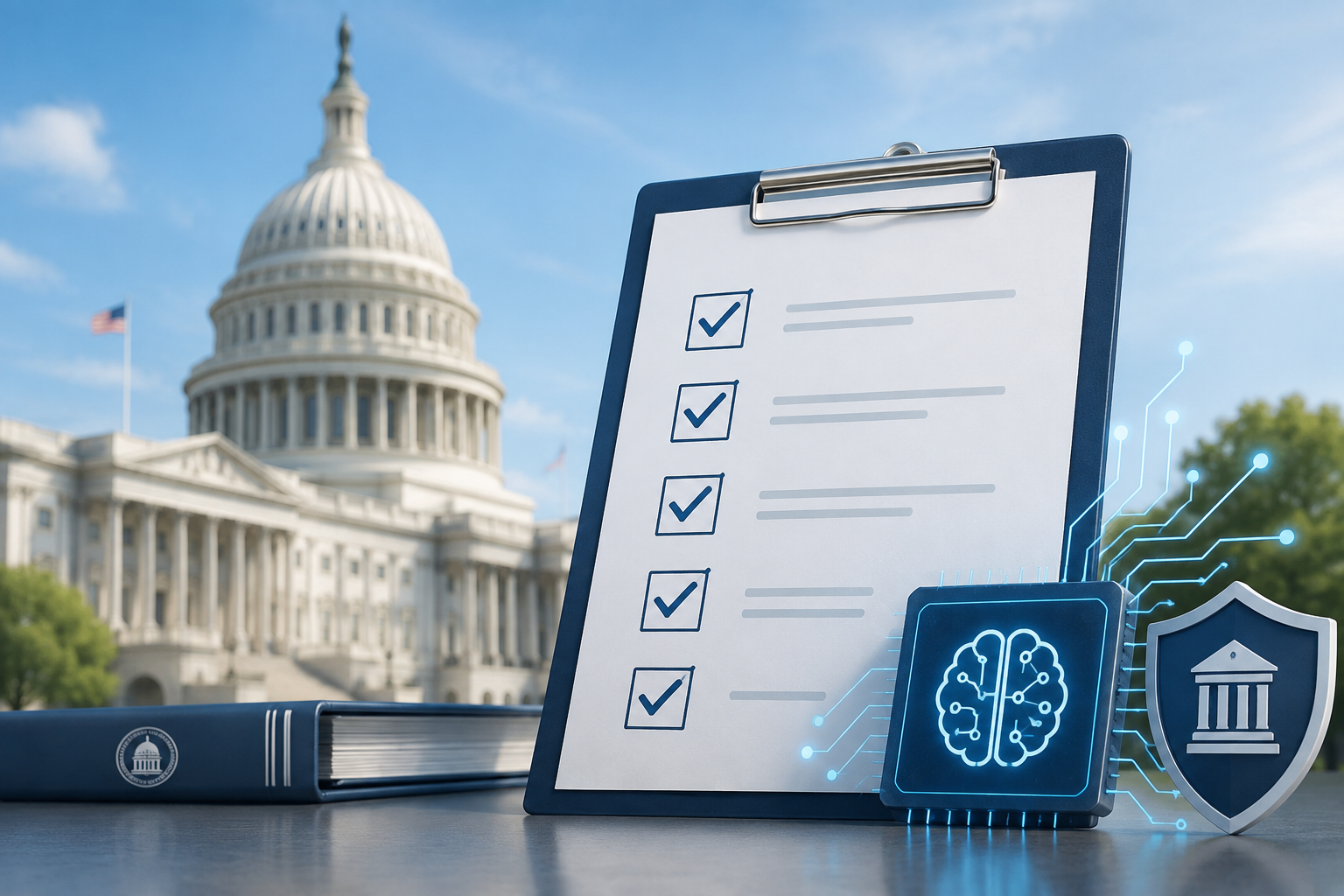
Artificial intelligence is creating new opportunities for government agencies to improve operations, analyze information, automate repetitive processes, and deliver better services. But procuring AI is different from purchasing conventional software.
AI systems can introduce unique considerations involving data security, privacy, model performance, transparency, cybersecurity, accessibility, integration, and ongoing governance. That makes a structured AI procurement checklist for government agencies an important part of evaluating potential solutions and vendors.
Before moving forward with an AI procurement, agencies should consider these key areas.
1. Define the Mission and Use Case
Start with the problem—not the technology.
Agencies should clearly identify what the AI solution is expected to accomplish, who will use it, what decisions it may influence, and how success will be measured.
Key questions include:
- What mission or operational problem does the solution address?
- Is AI actually necessary for the use case?
- Who are the users and stakeholders?
- What measurable outcomes should the solution deliver?
- Will AI assist personnel or make automated decisions?
Clear requirements make it easier to compare vendors and prevent agencies from procuring technology without a defined operational purpose.
2. Evaluate Data Requirements and Governance
Data is fundamental to most AI systems. Agencies should understand exactly what information an AI solution requires and how that information will be handled.
Review where data is stored and processed, what information the vendor can access, retention and deletion practices, and whether agency information may be used to train or improve external AI models.
Procurement teams should also evaluate applicable privacy, records-management, data-governance, and information-handling requirements.
3. Assess Cybersecurity
AI does not eliminate traditional cybersecurity requirements. In some situations, it can introduce additional attack surfaces and risks.
Agencies should evaluate the solution’s security architecture, authentication and authorization controls, encryption, logging, vulnerability management, incident-response processes, and third-party dependencies.
Security requirements should be incorporated into the procurement process early rather than addressed after deployment.
4. Examine AI Performance and Transparency
A successful demonstration does not necessarily prove that an AI system will perform reliably in a government environment.
Ask vendors how their system was tested, which metrics are used to evaluate performance, what known limitations exist, and how outputs can be reviewed or validated.
For higher-impact applications, agencies should also consider explainability, human oversight, error handling, bias testing, and procedures for challenging or correcting AI-generated results.
5. Determine Applicable Compliance Requirements
There is no single compliance checklist that applies to every government AI procurement.
Requirements can vary depending on the agency, jurisdiction, information involved, hosting environment, system impact level, and intended use.
Procurement and technical teams should identify applicable cybersecurity, privacy, accessibility, records-management, acquisition, and AI-governance requirements before selecting a solution.
Vendors should be prepared to provide documentation supporting relevant requirements rather than relying on broad statements that a product is simply “government compliant.”
6. Review Integration and Technical Architecture
An AI solution needs to work within the agency’s existing technology environment.
Evaluate APIs, identity and access management, cloud or on-premises deployment requirements, data formats, interoperability, monitoring, scalability, and integration with existing systems.
Agencies should also consider vendor lock-in. Determine how agency data, configurations, and other relevant assets can be exported or migrated if the organization later changes platforms.
7. Establish Human Oversight
AI should have clearly defined boundaries.
Agencies should determine when human review is required, who is responsible for validating outputs, what happens when the system produces an incorrect or uncertain result, and which decisions should never be fully automated.
The level of oversight should reflect the potential consequences of an error.
8. Evaluate the Vendor, Not Just the Product
AI procurement should include due diligence on the organization providing the technology.
Consider the vendor’s technical capabilities, security practices, implementation approach, support model, subcontractors and technology dependencies, documentation, and ability to maintain the system throughout its expected lifecycle.
Agencies should also understand what happens if an underlying AI model, API, or third-party service changes.
9. Define Lifecycle Monitoring
AI procurement does not end at deployment.
Model behavior and system performance can change over time. Agencies should establish processes for monitoring accuracy, security, reliability, costs, user feedback, incidents, and other appropriate performance indicators.
Contracts should clearly define responsibilities for updates, maintenance, testing, reporting, and remediation.
10. Plan for Exit and Continuity
Before signing an AI contract, ask what happens when it ends.
Agencies should understand how their data will be returned or destroyed, how services can be transitioned, what dependencies exist, and whether operations can continue if a vendor or underlying AI provider becomes unavailable.
Exit planning reduces operational risk and gives agencies greater control over long-term technology decisions.
Government AI Procurement Checklist
Before selecting an AI solution, procurement teams should be able to answer:
✓ Is the mission need clearly defined?
✓ Are measurable success criteria established?
✓ Are data ownership, access, retention, and deletion requirements documented?
✓ Have cybersecurity and privacy requirements been evaluated?
✓ Can the vendor explain how the AI system is tested and monitored?
✓ Are limitations and potential failure modes understood?
✓ Is appropriate human oversight built into the workflow?
✓ Have applicable compliance and governance requirements been identified?
✓ Can the technology integrate with existing agency systems?
✓ Are ongoing monitoring and support responsibilities defined?
✓ Is there a plan for portability, transition, and contract termination?
Building AI That Serves the Mission
Government agencies have an opportunity to use AI to improve efficiency and mission outcomes, but successful adoption depends on more than selecting the latest technology.
Effective government AI procurement requires a deliberate evaluation of the mission, data, security, performance, governance, integration, vendor, and long-term operational risks.
Finally Free Productions (FFP) works at the intersection of technology, digital solutions, and government requirements. As agencies explore AI-enabled capabilities, a procurement strategy built around security, accountability, interoperability, and measurable outcomes can help turn AI experimentation into sustainable mission value.
Looking for support with an AI or technology initiative? Contact Finally Free Productions to discuss your agency’s requirements and explore an approach aligned with your mission.
