
 All
All AI & ML
 Healthcare
 Education
 Games
Games Fitness
 Business
 Webapps
 Websites
 More
More Case Studies
 Startup
 Web3 Development
 Capabilities
 Game Development
 Website Development
 Prototyping Services
 Mobile App Development
 Government Contracts
 Client Dashboard
 Design Process
 IP Protection
 Project Management
 Working with Finally Free
 FAQ
FAQ How to Videos
 About FFP
 Meet The Team
 Press
Press- Our Work
-
-
PORTFOLIO
OTHERS
-
-
- Services
-
- How We Work
-
- Resources
-
- About Us
-
- Contact Us
- Let’s Talk
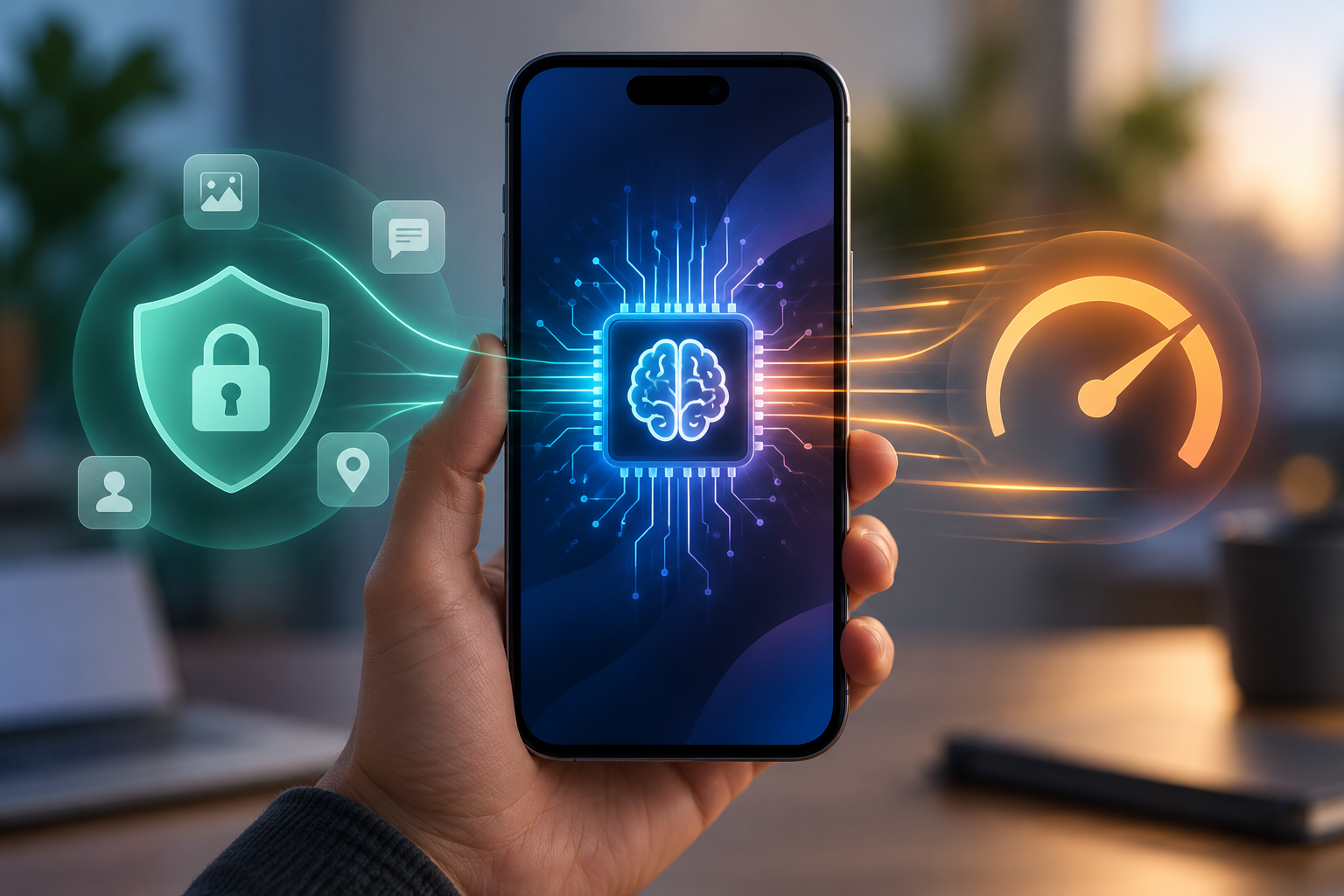
Artificial intelligence is becoming a core part of the mobile experience. From intelligent search and personalized recommendations to image processing and voice features, AI can make apps faster, smarter, and more useful.
But an important shift is happening behind the scenes: more AI processing can now take place directly on a user’s smartphone rather than relying exclusively on cloud servers.
This approach, known as on-device AI, has significant implications for mobile app privacy, performance, reliability, and development.
What Is On-Device AI?
On-device AI refers to artificial intelligence and machine learning workloads that run locally on a smartphone, tablet, or other user device.
In a traditional cloud-based AI architecture, an app may collect information, transmit it to a remote server for processing, and then return the result to the device.
With on-device AI, some or all of that computation happens locally.
Modern mobile hardware increasingly includes processors and accelerators designed to handle machine learning workloads efficiently. Combined with increasingly optimized AI models, these capabilities allow developers to implement sophisticated features without sending every request to the cloud.
How On-Device AI Can Improve Mobile App Privacy
Privacy is one of the strongest potential advantages of on-device processing.
When sensitive information can be processed locally, an application may not need to transmit that information to an external server simply to perform an AI task.
Consider an app that analyzes photos. A cloud-based implementation may require uploading an image for analysis. An on-device model could potentially analyze the image locally and return a result without the original photo leaving the device.
Similar approaches can be useful for features involving text, audio, behavioral signals, or other potentially sensitive information.
However, on-device processing does not automatically make an app private. Developers still need appropriate data collection practices, secure storage, permissions, encryption, and transparent privacy policies.
On-device AI is a technical tool that can support a privacy-conscious architecture—not a substitute for one.
Faster Responses and Lower Latency
Performance is another major reason development teams are exploring on-device AI.
Cloud AI introduces several steps between an action and its result:
Device → Network → Server → AI Processing → Network → Device
Every step can introduce latency.
When the necessary model runs locally, the workflow can become:
Device → AI Processing → Result
For the right workloads, removing network round trips can make AI-powered functionality feel significantly more responsive.
This can be particularly valuable for real-time experiences such as camera effects, predictive interfaces, voice processing, accessibility tools, image recognition, and intelligent text features.
AI Features That Can Work Without an Internet Connection
On-device AI can also enable functionality when connectivity is limited or unavailable.
A mobile app that depends entirely on cloud inference may lose important features when users enter areas with poor connectivity. Local inference can allow supported AI functionality to continue operating without a constant connection.
That can make on-device processing especially attractive for apps designed for travel, field operations, industrial environments, healthcare workflows, remote locations, or other situations where reliable connectivity cannot be assumed.
Potential Cost Benefits
Cloud AI isn’t free.
Every AI request sent to cloud infrastructure can contribute to API, compute, bandwidth, storage, and infrastructure expenses.
For applications operating at significant scale, those costs can become substantial.
Moving appropriate workloads onto users’ devices can reduce the number of server-side inference requests required. That doesn’t eliminate infrastructure costs, but it can change the economics of deploying AI features at scale.
Developers must balance those savings against other considerations, including model development, optimization, testing, application size, battery consumption, and device compatibility.
The Tradeoffs of On-Device AI
On-device AI isn’t the right solution for every application.
Mobile devices have limited memory, processing power, storage, and battery capacity compared with large cloud computing environments. Developers may need to compress, quantize, or otherwise optimize models before they can run efficiently on mobile hardware.
Device fragmentation is another challenge.
A model that performs well on a recent flagship smartphone may behave differently on older or lower-powered hardware. Mobile development teams therefore need to test AI functionality across realistic device configurations.
Model distribution and updates must also be considered. Larger models can increase app download sizes, while frequently changing models may require a strategy for securely delivering updates after installation.
On-Device AI vs. Cloud AI
The future of mobile AI is unlikely to be exclusively local or exclusively cloud-based.
For many applications, a hybrid AI architecture can offer a practical balance.
Smaller, latency-sensitive, or privacy-sensitive tasks can run locally, while computationally intensive workloads can be handled by cloud infrastructure.
For example, an app might use an on-device model to classify a user’s request and perform common tasks locally while routing more complex requests to a larger cloud model.
The right architecture depends on the application’s requirements, including model complexity, privacy expectations, latency targets, operating costs, supported devices, and connectivity requirements.
What This Means for Mobile App Development
On-device AI introduces a new architectural question for development teams.
Instead of simply asking:
“Where can we add AI?”
Teams should also ask:
“Where should the AI actually run?”
That decision can influence application architecture, UX, security, infrastructure costs, performance, and privacy from the earliest stages of development.
For businesses planning new mobile products, these considerations are increasingly worth evaluating during product strategy and technical architecture—not after development has already begun.
Building Smarter Mobile Experiences
On-device AI gives mobile development teams another powerful option for creating intelligent applications.
Used appropriately, local AI processing can reduce latency, enable offline functionality, minimize unnecessary data transmission, and reduce dependence on cloud infrastructure.
Cloud AI will remain essential for many advanced workloads, but developers no longer need to assume that every intelligent feature belongs on a remote server.
At Finally Free Productions (FFP), we help organizations design and develop mobile applications around the technologies and architectures that best fit their product requirements. As AI capabilities continue moving onto mobile hardware, thoughtful decisions about what happens on the device—and what happens in the cloud—will become an increasingly important part of building secure, responsive, and scalable mobile experiences.
