
 All
All AI & ML
 Healthcare
 Education
 Games
Games Fitness
 Business
 Webapps
 Websites
 More
More Case Studies
 Startup
 Web3 Development
 Capabilities
 Game Development
 Website Development
 Prototyping Services
 Mobile App Development
 Government Contracts
 Client Dashboard
 Design Process
 IP Protection
 Project Management
 Working with Finally Free
 FAQ
FAQ How to Videos
 About FFP
 Meet The Team
 Press
Press- Our Work
-
-
PORTFOLIO
OTHERS
-
-
- Services
-
- How We Work
-
- Resources
-
- About Us
-
- Contact Us
- Let’s Talk
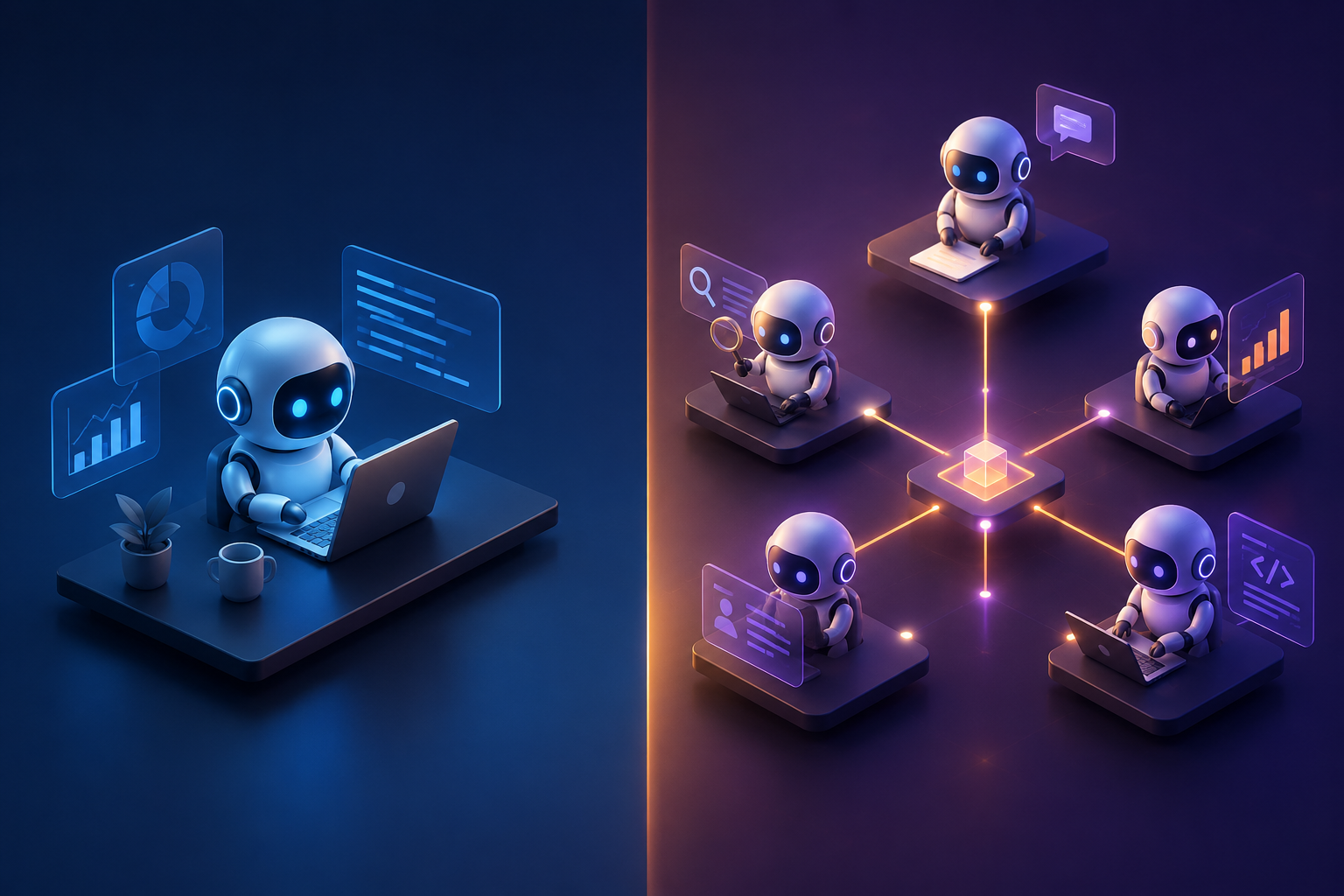
AI agents are quickly moving from experimental technology to practical business tools. Companies can now deploy AI to analyze information, interact with software, automate workflows, assist employees, communicate with customers, and coordinate increasingly complex processes.
But businesses considering AI agents face an important architectural decision: Should you use a single AI agent or a multi-agent system?
The answer depends less on which technology sounds more advanced and more on the complexity of the problem you’re trying to solve.
What Is a Single AI Agent?
A single AI agent is an AI-powered system designed to perform a task—or a related collection of tasks—within one primary agent architecture.
The agent may connect to databases, APIs, business applications, knowledge bases, or other tools to complete its work.
For example, a company might deploy one AI agent to:
- Qualify incoming sales leads
- Answer questions from an internal knowledge base
- Summarize documents
- Generate reports
- Assist customer support teams
- Automate repetitive administrative processes
Single-agent systems can be particularly effective when the workflow has a clearly defined objective and does not require extensive coordination among independent AI roles.
Advantages of a Single AI Agent
A single-agent architecture can offer several benefits:
Lower complexity: There are fewer interactions and dependencies to design, monitor, and troubleshoot.
Faster implementation: For focused use cases, businesses may be able to move from prototype to deployment more quickly.
Simpler governance: Monitoring permissions, outputs, data access, and system behavior is generally more straightforward.
Potentially lower operating costs: Fewer agent interactions can mean less model usage and infrastructure overhead.
For many organizations beginning their AI automation journey, a well-designed single agent may be all they need.
What Is a Multi-Agent System?
A multi-agent system uses multiple AI agents that perform specialized roles and coordinate to accomplish a broader objective.
Instead of asking one agent to handle an entire process, the workflow can be divided among agents with different responsibilities.
Consider an AI-powered market research workflow. One agent might gather information, another could analyze competitors, another could evaluate trends, and a final agent could synthesize those findings into a report.
The agents function more like a coordinated digital team than a single general-purpose assistant.
Advantages of Multi-Agent Systems
Multi-agent architectures can become valuable when business processes involve multiple specialized functions.
Potential benefits include:
Specialization: Individual agents can be designed around specific responsibilities, tools, instructions, or data sources.
Workflow decomposition: Complex processes can be divided into smaller, more manageable tasks.
Parallel processing: Certain independent tasks may be completed simultaneously rather than sequentially.
Modularity: Individual agents or workflow components may be modified without redesigning the entire system.
Scalability for complex processes: Multi-agent systems can support sophisticated workflows spanning several business functions and software environments.
However, additional agents also introduce additional complexity.
Single AI Agent vs Multi-Agent System: Key Differences
The primary distinction is coordination and specialization.
A single agent centralizes reasoning and execution within one primary system. A multi-agent architecture distributes responsibilities across multiple specialized agents that must communicate or coordinate.
That creates an important tradeoff.
Multi-agent systems can provide greater specialization and flexibility, but they may also require more sophisticated orchestration, monitoring, security controls, testing, and cost management.
Businesses therefore should not assume that more agents automatically produce a better AI solution.
Which AI Architecture Does Your Business Need?
Start with the business process—not the number of agents.
A single AI agent may be appropriate when:
- The objective is clearly defined.
- The workflow is relatively contained.
- One agent can effectively access the necessary tools and information.
- Simplicity, speed, and cost control are priorities.
- The organization is testing an AI use case before expanding it.
A multi-agent system may be appropriate when:
- The workflow contains several distinct specialist roles.
- Multiple systems or data environments must be coordinated.
- Tasks benefit from being separated or performed in parallel.
- The process requires several stages of analysis, review, or execution.
- The organization needs a modular architecture for a complex automation environment.
There is also a third option: start with one agent and expand only when the workflow justifies it.
This approach can help businesses validate the use case, understand operational requirements, establish performance benchmarks, and identify where specialized agents would create measurable value.
Don’t Automate Complexity Without a Strategy
The success of an AI agent implementation depends on much more than the underlying model.
Businesses should also consider data quality, integrations, permissions, cybersecurity, human oversight, error handling, monitoring, compliance requirements, operating costs, and measurable performance goals.
Before deploying autonomous or semi-autonomous agents into critical workflows, organizations should establish clear boundaries around what the system can access, what actions it can take, and when a human must review or approve its decisions.
The best AI architecture is ultimately the one that solves the business problem reliably, securely, and cost-effectively.
Build the Right AI System for Your Business
At Finally Free Productions (FFP), we help organizations evaluate where artificial intelligence and automation can create practical business value.
Whether your organization needs a focused AI agent, a sophisticated multi-agent workflow, or an integrated AI automation solution, the process should begin with understanding the objective, existing systems, data, security requirements, and desired outcomes.
Considering AI agents for your organization? Contact Finally Free Productions to discuss your business process and explore an AI architecture designed around your operational needs.
