
 All
All AI & ML
 Healthcare
 Education
 Games
Games Fitness
 Business
 Webapps
 Websites
 More
More Case Studies
 Startup
 Web3 Development
 Capabilities
 Game Development
 Website Development
 Prototyping Services
 Mobile App Development
 Government Contracts
 Client Dashboard
 Design Process
 IP Protection
 Project Management
 Working with Finally Free
 FAQ
FAQ How to Videos
 About FFP
 Meet The Team
 Press
Press- Our Work
-
-
PORTFOLIO
OTHERS
-
-
- Services
-
- How We Work
-
- Resources
-
- About Us
-
- Contact Us
- Let’s Talk
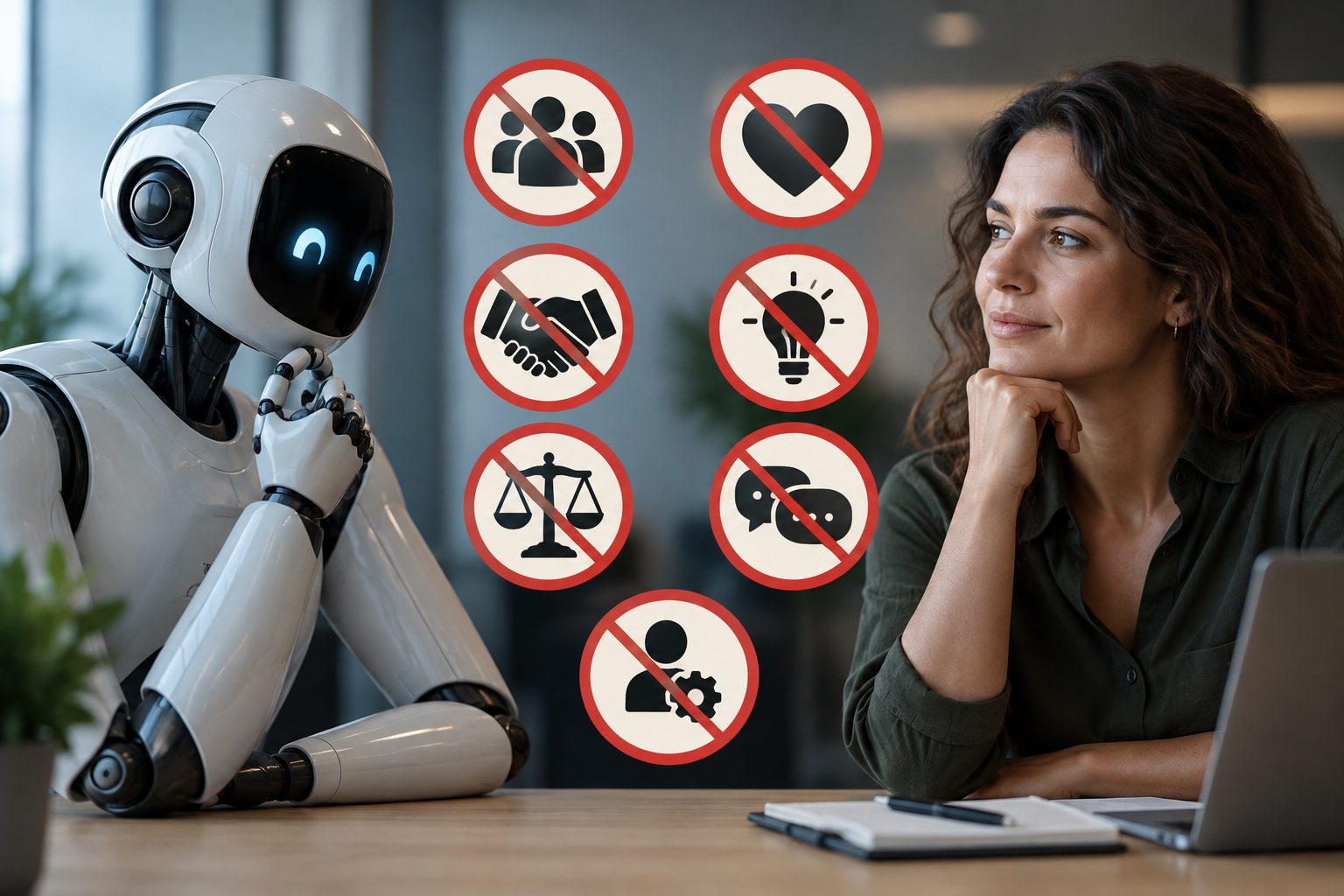
Artificial intelligence is changing how businesses operate. From generating content and analyzing data to answering customer questions and streamlining repetitive workflows, AI can help organizations accomplish more in less time.
But being able to automate a task does not necessarily mean you should fully automate it.
The strongest AI strategies recognize where automation creates efficiency—and where human judgment, accountability, creativity, and empathy remain essential. Here are seven business tasks that organizations should think carefully about before handing them entirely to AI.
1. High-Stakes Business Decisions
AI can process enormous amounts of information and identify patterns that humans may overlook. That makes it a valuable decision-support tool.
However, major decisions involving investments, hiring, partnerships, restructuring, pricing, or company strategy should not depend exclusively on an AI system.
AI can provide analysis and recommendations, but experienced leaders should evaluate the context, assumptions, risks, and potential consequences before making the final call.
Best approach: Use AI to inform decisions, not own them.
2. Hiring and Employee Management
AI can help companies screen applications, organize candidate information, prepare interview questions, and analyze workforce data. Fully automating hiring or employee-management decisions, however, introduces significant risks.
Algorithms may inherit biases from training data or fail to recognize qualities that do not translate neatly into structured information. Employee performance, potential, communication skills, and cultural contributions also require context.
Human involvement is especially important when decisions affect someone’s employment, compensation, promotion, or career.
3. Sensitive Customer Service
AI assistants can handle routine questions efficiently, making them useful for customer support. Problems arise when businesses attempt to automate every customer interaction.
A frustrated customer dealing with a billing dispute, service failure, complicated technical problem, or unusual circumstance may need more than a generated response.
Human representatives can interpret nuance, demonstrate empathy, make exceptions, and take responsibility for resolving difficult situations.
Best approach: Automate routine support while creating a clear path to a human for complex or sensitive issues.
4. Brand Strategy and Creative Direction
Generative AI can produce impressive amounts of content, including articles, images, concepts, advertisements, scripts, and social media posts.
What it cannot independently determine is what your company should stand for.
Brand positioning, creative direction, storytelling, and major campaign concepts should remain connected to people who understand the organization’s customers, history, competitive environment, goals, and values.
AI can accelerate the creative process, but humans should continue directing it.
5. Legal, Compliance, and Contract Decisions
AI can be extremely useful for summarizing documents, organizing information, conducting preliminary research, and identifying potential issues.
That does not make it a replacement for qualified legal or compliance professionals.
AI-generated information can be incomplete, outdated, misinterpreted, or simply incorrect. The consequences become particularly serious when contracts, regulations, intellectual property, government requirements, or legal obligations are involved.
Use AI to increase efficiency—but keep appropriate professionals responsible for review and approval.
6. Cybersecurity and Critical Technology Changes
AI is becoming an important cybersecurity and IT tool. It can monitor systems, identify unusual behavior, assist with troubleshooting, and recommend responses.
Giving an autonomous system unrestricted authority to make critical infrastructure or security changes can create another source of risk.
Significant actions involving production environments, access permissions, sensitive data, security policies, or system architecture should have safeguards and appropriate human authorization.
Automation should strengthen security controls rather than bypass accountability.
7. Building Important Business Relationships
AI can help prepare emails, research prospects, summarize meetings, maintain CRM records, and suggest follow-up actions. Those capabilities can make sales and relationship management significantly more efficient.
But relationships themselves should not become fully automated.
Customers, partners, employees, vendors, and stakeholders eventually recognize the difference between genuine engagement and an automated sequence. Important relationships depend on trust, listening, negotiation, judgment, and authentic communication.
Let AI handle administrative work so your people have more time for the conversations that matter.
The Goal Isn’t Maximum Automation
The question businesses should ask is not, “How much can we automate?”
A better question is, “Where can AI create the most value while keeping the right people involved?”
AI is particularly effective at accelerating research, processing information, generating first drafts, identifying patterns, and handling repetitive work. Humans remain essential when a task demands accountability, nuanced judgment, empathy, strategic direction, or responsibility for significant consequences.
For many organizations, the competitive advantage will not come from replacing people with AI. It will come from designing better workflows in which people and AI each handle the work they do best.
At Finally Free Productions (FFP), we help organizations explore technology, digital solutions, and AI-enabled workflows with a focus on practical business outcomes. As AI capabilities continue to evolve, thoughtful implementation will matter just as much as the technology itself.
The businesses that succeed with AI won’t necessarily be the ones that automate the most. They’ll be the ones that automate intelligently.
