
 All
All AI & ML
 Healthcare
 Education
 Games
Games Fitness
 Business
 Webapps
 Websites
 More
More Case Studies
 Startup
 Web3 Development
 Capabilities
 Game Development
 Website Development
 Prototyping Services
 Mobile App Development
 Government Contracts
 Client Dashboard
 Design Process
 IP Protection
 Project Management
 Working with Finally Free
 FAQ
FAQ How to Videos
 About FFP
 Meet The Team
 Press
Press- Our Work
-
-
PORTFOLIO
OTHERS
-
-
- Services
-
- How We Work
-
- Resources
-
- About Us
-
- Contact Us
- Let’s Talk
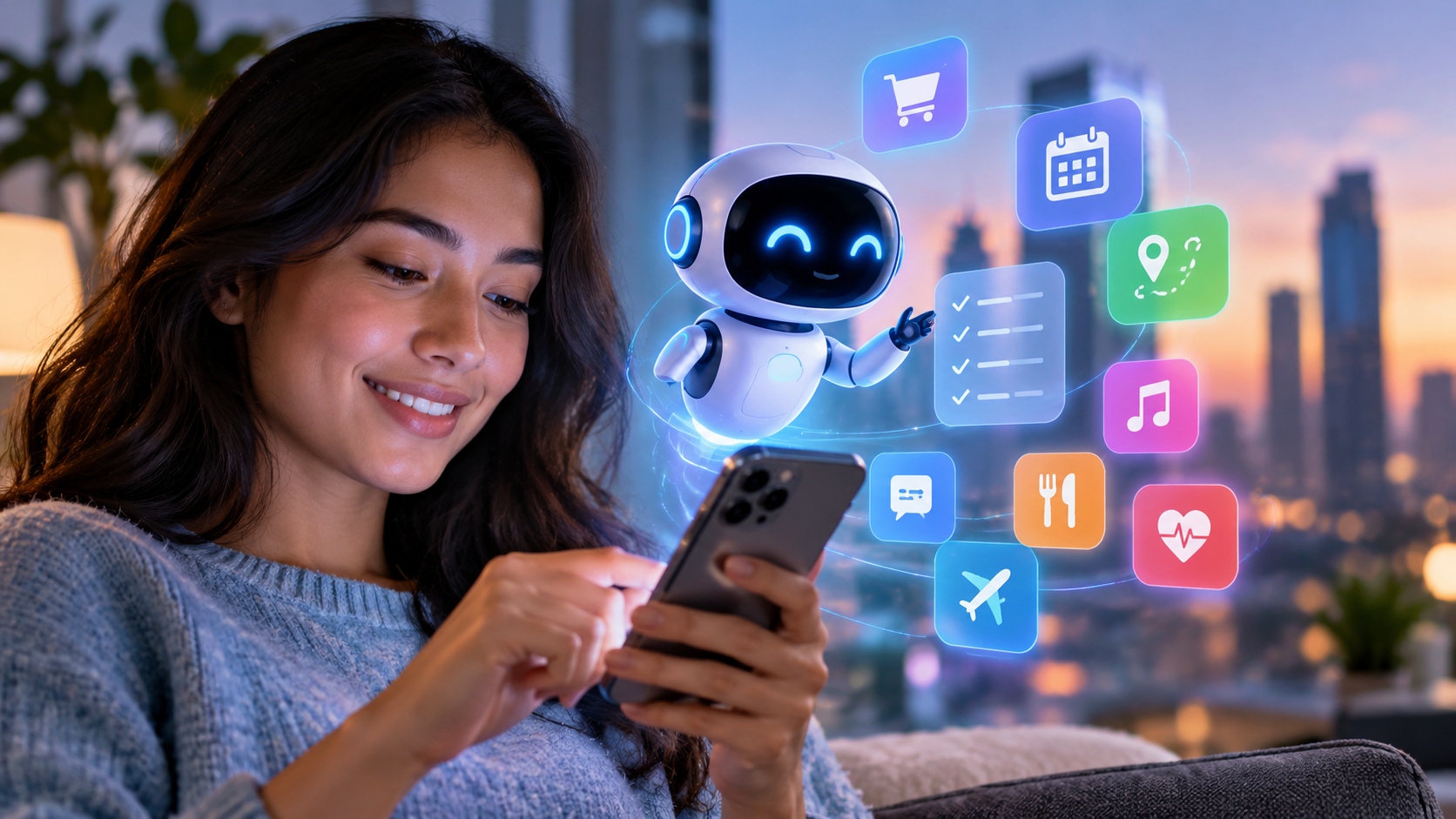
Mobile apps have traditionally depended on users to do the work: open the app, navigate menus, enter information, search for what they need, and complete each step manually.
AI agents are beginning to change that model.
Instead of simply responding to individual commands, AI agents can understand a user’s goal, interpret available information, make decisions within defined boundaries, and carry out multiple steps on the user’s behalf.
For businesses building the next generation of digital products, this shift creates an opportunity to rethink what a mobile app can actually do.
What Are AI Agents?
An AI agent is a software system designed to work toward a goal with a degree of autonomy. Depending on how it is built, an agent can process user requests, access approved tools or data, determine which actions are necessary, and execute a sequence of tasks.
Imagine a travel app, for example. A traditional app might require users to search for flights, compare hotels, review transportation options, and organize an itinerary themselves.
An AI-agent-powered experience could allow someone to say:
“Help me plan a three-day business trip within my budget.”
The agent could potentially gather the necessary information, compare available options, build an itinerary, and—with appropriate permissions and safeguards—help execute the next steps.
That changes the app experience from navigation-driven to goal-driven.
Mobile Apps Are Becoming More Personalized
Personalization is another major opportunity for AI agents in mobile apps.
Traditional personalization often relies on predefined rules: users who perform a certain action receive a particular recommendation or experience. AI-powered systems can potentially consider a much broader range of context and adapt their responses accordingly.
A fitness app could adjust recommendations based on progress and preferences. An e-commerce application could help users narrow hundreds of products down to a few relevant choices. A business application could prioritize information based on an employee’s responsibilities and current tasks.
The goal isn’t simply to add an AI chatbot to an existing application. The larger opportunity is to make the entire app experience more intelligent and adaptive.
From Tapping Through Screens to Asking for Outcomes
One of the most interesting changes created by AI agents is how users interact with software.
For years, mobile UX has focused on buttons, menus, forms, filters, and screens. Those interfaces aren’t disappearing, but AI creates another interaction layer: intent.
Instead of figuring out which part of an application performs a task, users can increasingly describe the outcome they want.
An AI agent can then help translate that intent into actions.
This can reduce friction in complex workflows and make sophisticated functionality easier to access—especially in applications involving large amounts of information or repetitive tasks.
AI Agents Can Automate Multi-Step Workflows
AI agents become especially useful when an application requires users to move through several repetitive steps.
Depending on the product and available integrations, an agent might:
Gather information from multiple approved sources
Summarize documents or data
Generate recommendations
Complete repetitive workflows
Trigger actions through connected APIs
Monitor information and alert users when something changes
Guide users through complex processes
For businesses, this means mobile applications can evolve from passive software tools into systems that actively help users accomplish work.
Trust, Security, and Human Control Matter
Giving AI systems more autonomy also introduces new product and engineering challenges.
Developers need to consider what information an agent can access, which actions it is authorized to perform, when confirmation should be required, and what happens when the AI is uncertain.
Security, privacy, transparency, monitoring, and human oversight should therefore be considered during product design—not added after an AI feature has already been built.
The best AI-powered applications won’t necessarily be the ones that automate everything. They will be the ones that apply automation where it creates meaningful value while keeping users appropriately informed and in control.
What AI Agents Mean for the Future of Mobile App Development
The rise of AI agents doesn’t mean traditional mobile apps are going away. It means their role is evolving.
Tomorrow’s strongest applications may combine familiar mobile interfaces with conversational AI, intelligent recommendations, automated workflows, and agents capable of taking approved actions.
For companies planning a new mobile product—or modernizing an existing one—the important question is no longer simply:
“Where can we add AI?”
A better question is:
“Which parts of our users’ journey can AI make dramatically easier?”
That distinction can be the difference between adding an AI feature because it’s popular and creating an AI-powered product that solves a real problem.
Building Smarter Mobile Experiences with Finally Free Productions
At Finally Free Productions (FFP), we help businesses turn ambitious digital product ideas into practical, user-focused experiences.
As AI agents continue to reshape mobile app development, organizations have an opportunity to build applications that do more than display information or wait for user input. They can create intelligent experiences designed to understand needs, reduce repetitive work, and help users reach their goals faster.
Whether you’re exploring an AI-powered mobile application, adding intelligent capabilities to an existing product, or evaluating how AI agents could fit into your business, the first step is identifying where the technology can deliver measurable value.
Have an idea for an AI-powered app? Connect with Finally Free Productions to explore how it can become a real product.
